The Most Expensive Fire Alarm Upgrade Is the One You Weren't Planning For
Most organisations don't start thinking about replacing their fire alarm system until a problem forces the conversation.
A critical fault occurs. A major component becomes obsolete. Replacement parts are no longer available. An inspection highlights concerns. Suddenly, what was once a future consideration becomes an urgent requirement.
The challenge is that fire alarm systems rarely fail according to budget cycles.
By the time many organisations begin considering replacement options, they are already working against the clock.
Why Age Matters
Many fire alarm systems continue operating well beyond ten years of age.
That doesn't automatically mean that all parts require replacement. However, it should prompt some important questions.
- How long will replacement parts remain available?
- What is the manufacturer's recommended lifespan for the detectors?
- Does the system still reflect the current use of the building?
- Could future expansion be accommodated?
- What level of investment may be required over the next three to five years?
These are planning questions, not emergency questions.
And they are far easier to answer while the system is still functioning reliably.
More Than Just Compliance
Fire alarm systems are often viewed through the lens of compliance.
Businesses know they need them. They know they need to be serviced. They know they need to be tested.
However, compliance is only part of the story.
Unlike many other building systems, fire alarms are life-safety systems. Their purpose is not simply to satisfy a regulatory requirement but to provide early warning when people need it most.
When a fire occurs, there is rarely a second opportunity to detect it quickly, warn occupants and support a safe evacuation.
That is why decisions around ageing equipment, system suitability and future planning matter so much.
The question isn't simply whether a fire alarm system is working today.
The question is whether you would be confident relying on it during an emergency.
The Organisations That Manage This Best
One of the most common conversations we have is with organisations whose systems are still working.
The panel looks healthy.
Routine servicing is taking place.
There are no major concerns.
Yet the system may be 10, 15 or even 20 years old.
Manufacturers may no longer support parts of the system. Building layouts may have changed. Future upgrade requirements may never have been considered.
Nothing is wrong today.
The concern is what happens tomorrow.
The organisations that manage this best are rarely those with the newest systems.
They are the organisations that understand what they have, what condition it's in and what their options are over the next three to five years.
As a result, they avoid unexpected expenditure, minimise disruption and remain in control of the decision-making process.
Waiting Can Be Costly
When an ageing system finally reaches the point where replacement can no longer be delayed, options become more limited.
Budgets may not be available.
Timescales become compressed.
Decisions are made under pressure.
In some cases, organisations find themselves replacing systems earlier than planned simply because the opportunity to prepare has been missed.
That is why waiting until something goes wrong is rarely the most cost-effective strategy.
How Scan Can Help
At Scan Alarms & Security Systems, we regularly work with organisations whose systems are approaching the stage where future planning becomes essential.
Our Fire Alarm Compliance & Site Survey is designed to provide clarity.
We can assess the age and condition of your existing system, identify equipment approaching obsolescence, review compliance considerations and highlight any areas that may require attention in the coming years.
Where appropriate, we can also help develop a practical upgrade strategy, allowing organisations to budget and plan ahead rather than being forced into unexpected expenditure following a fault or system failure.
Importantly, this isn't always about replacing a system immediately.
For many businesses, the greatest value comes from understanding what may be required tomorrow, building a realistic budget and ensuring future investment happens on your terms rather than being dictated by a fault, an inspection or a failure.
Plan Before You Have To
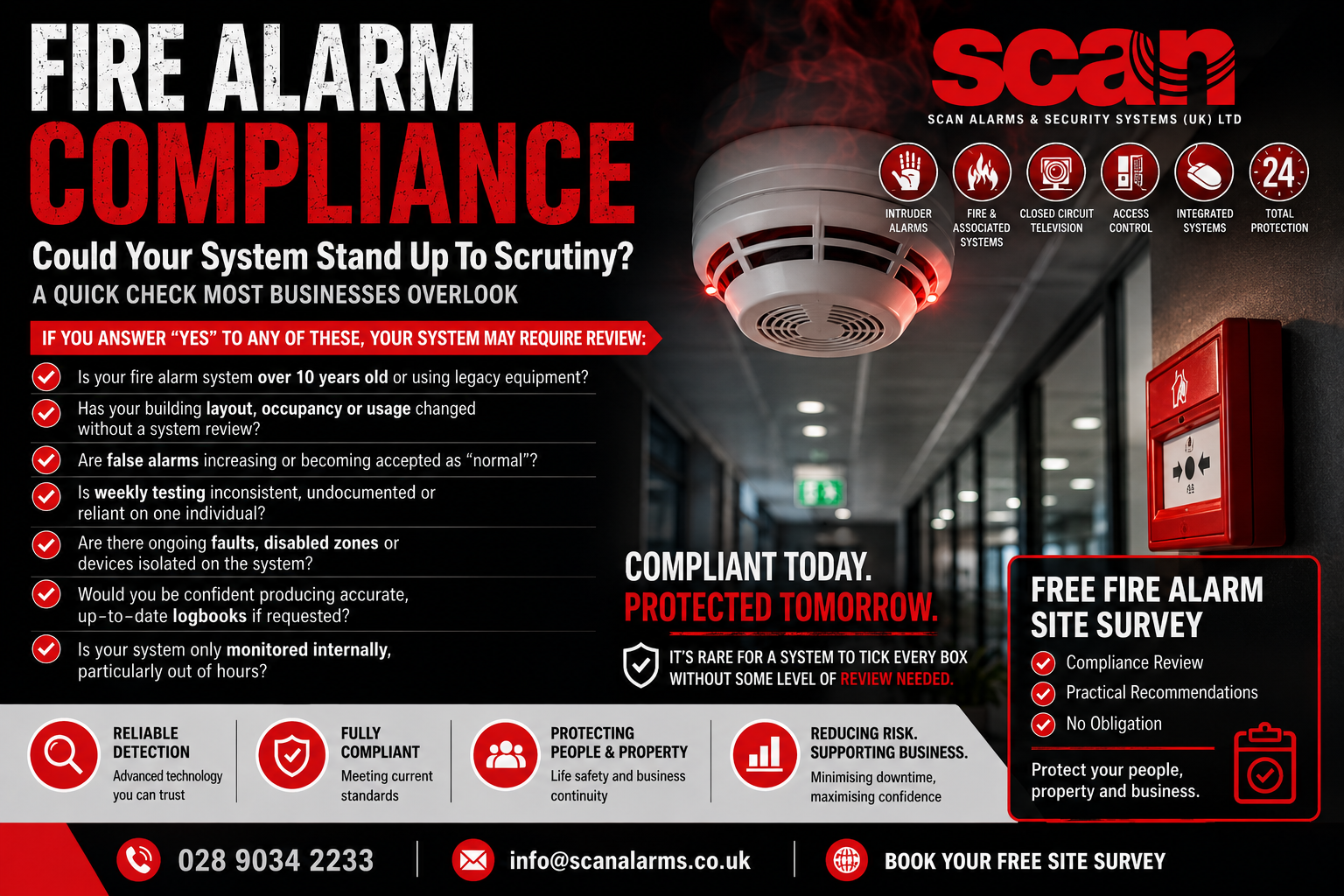
If your fire alarm system is over ten years old, now may be the ideal time to review your options.
Not because something is wrong today.
But because the best time to plan for an ageing fire alarm system is before it becomes a problem.
Book a Free Fire Alarm Compliance & Site Survey and let our team help you understand what lies ahead, so future decisions can be made on your terms, not your system's.
028 9034 2233